

Reports and Documentation
This page showcases high-level reports, studies, essays, and texts. This work is primarily research oriented and only a sample of each document is included below. For the full document, please fill out a contact inquiry or email archonanuga@gmail.com.

Resilience: A Paper
Post COP26 Research Paper
" To define resiliency, one must first consider the context. The literal definition is ‘the capacity to recover quickly from difficulties; toughness.’ This definition is concise and encompasses the ideals overall. However, the idea of resiliency in the modern day and, more importantly, in modern society, requires a more human-focused approach. For that, we can consider this alternative definition: ‘The ability to adapt to difficult situations. When stress, adversity, or trauma strikes, you still experience anger, grief, and pain, but you can keep functioning - both physically and psychologically.’ Considering resiliency at the psychological scale brings us closer to looking at resiliency from a human scale, more accurately - an emotional and mental scale. Ultimately, when we look at resiliency as urban design professionals, we are looking into not only socioeconomic factors but climate factors. As global warming causes biome drift and rising sea levels change city limits and neighborhoods, we must also look into the climate and how to be resilient to it and adapt to these changes or remedy them. With this in mind, the bulk of my research looks into climate resiliency and its impacts on other forms of resiliency, such as the aforementioned social, psychological, or economic. For that, we define resiliency as: ‘the ability to anticipate, prepare for, and respond to hazardous events, trends, or disturbances related to climate.’ "
A Display Case for the Holy Chalice
Historical Research on the Cathedral of Valencia
" A divine sense of splendor and grandiloquence defines the Gothic style in Europe. These new building technologies allowed for Gothic buildings to grow vertically and create open, fantastical spaces with prismatic light from stained glass windows dancing within them. In addition to the colorful light, stained glass and rose windows also present moments from the bible in images, allowing those who cannot read to still know the Scripture. The idea of portraying the scripture without words appears in the carvings throughout Gothic buildings as well. These carvings usually include moments like the Epiphany or the Passion. Not only do these carvings add to the beauty of these Cathedrals, but allow passersby to see the scripture before even entering the Cathedral. Lastly, the use of gargoyles is very common in the Gothic style. Gargoyles, functionally, serve as downspouts for the gutters of the Cathedral. Spiritually, however, gargoyles serve as a deterrent for maladies and evil spirits, making them protectors of the Cathedral and adding to the divine rituals often employed at churches.This assertion of grandiosity in Christian Architecture also comes with the consensus of the wealth in Christianity, primarily Roman Catholicism.These ideas of wealth lead to Cathedrals in the Middle Ages to include methods of drawing in more patrons, such as being pilgrimage locations or housing a relic of Christianity. One of the most well-known relics is the Holy Grail, and with its fame, it brings many - the devout, the skeptical, the curious, and the fans of Arthurian legend - to its home in the Valencia Cathedral. Though this chalice - along with many other relics of its time - holds cultural and religious value, its value in the modern day comes from the tourist appeal. Thus, the relic appeal of Holy Chalice turns the Valencia Cathedral, a beautiful building with a rich history and religious background into a display case for the “real life Holy Grail”, the one seen in Indiana Jones, or the Davinci Code, or the hit TV show Merlin. Should we be celebrating the history of the Holy Chalice of Valencia and the chapel it now sits in, or should we be celebrating the popularity of the stories and myths about "


Adequacy in Design
Visual Assessment Tool for K-12 Educational Spaces
" Flexibility and Arrangement of Learning Spaces:
Clever Classrooms speaks about the importance of
Individualisation and how classrooms can support it based
on the diversity of classroom arrangements to allow for
a wider variety of learning and teaching styles. With this
in mind, a major finding in their research spoke about
the importance of breakout spaces for smaller, more
individualized learning opportunities and learning zones for
play-based learning - especially among younger pupils.
Opportunities for Ownership and Peer Appreciation:
Psychological research finds that personalizing a space you
spend a large amount of time in helps foster a sense of
self and a sense of self worth (McMillan 1997). In addition,
classrooms that display student projects, work, and art
encourage more participation and engagement in the
learning process (Ulrich 2004). In addition, FNI spoke of the
importance of transparency and students seeing the work
styles of other students.
Sustainability, Adaptability, and Comfortability:
ACPS’s Design Imperatives for High School 2022 spoke
of the importance of environmental and economical
sustainability and its presence in the learning space; the
importance of mobility and how learning is never ‘tethered’
to a specific place; the notions of a variety of learning
spaces - such as project-centered, student-crafted, and
inside/outside; and how spaces need to be built to for
the students, with ergonomics focused on the size of the
child and elements that are not solely focused on “adult
convenience.” "
MAKING, BREAKING, AND WHATEVER I DID
Design Making and Disruption Process Book
" I quickly learned that my design process
is entirely open-ended and changes depending
on my enthusiasm toward the
project. What I deem appropriate for a
project changes with the scale of the project, the duration, and how long I am invested in doing it. For example, some of the
quicker projects for me showed off my spontaneity and my ability to pick something
and “Just Do It” to completion. In contrast, the longer or ‘more tedious’ projects show off
my ability to think big first and zoom in. However, in the extremes, like the Additive/
Subtractive, where there were truly a hundred or so ‘iterative moves’ its a bit of a mix,
where I will start by ‘just doing, and as I’m exploring I find meaning, and start to lean
into creating an overarching concept. These design opportunities are something I might
bring into my future iterative processes. It was quick fun to go into something with very
little thought or pre-planning/conceptualization and find meaning in what came from
my stream of consciousness. "

Sainte Chapelle and Its Upper Cathedral
Historical Research on the Sainte Chapelle Cathedral in Paris
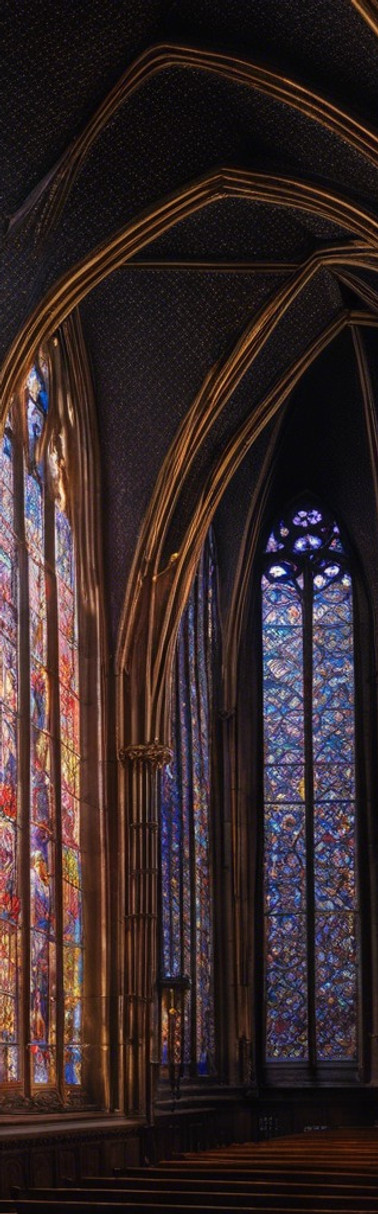
" The Sainte Chapelle in Paris is a French Gothic cathedral designed by Pierre de Montreuil and built in the 13th century. The chapel was built under a royal decree by King Louis the 9th to serve as a repository for the sacred relics he sought to collect so that he would be revered as the ‘most Christan king’. Most notably, King Louis IX saved the Crown of Thorns, said to be seated on the head of Jesus Christ when he was crucified, in a chest laid on a platform inside the baldachin of the upper chapel. The upper chapel of the Ste. Chapelle is one of the most beautiful naves in Gothic architecture, as its stained glass brings in divine light, and its form serves as an allusion to the Throne of Solomon. The trefoil arches and repetition of gilding and tracery creates a rich fabric of modules that serve to unify the form of the upper chapel through the proportions and the repetition of ratios. "
NSLC Architecture Program
Curriculum Development, Program Direction, and Conference Planning Notes
" Overall the program is robust, educational, and action-packed. In an ideal world, the program is busy but the pacing is manageable, more like an architecture school experience rather than simply a “summer camp.” However, things that are out of your control like bussing, field trip availability, and meeting spaces may require changes that break up the “intended” order and thus some days end up having 3 field trips and others have none. Truly, I believe that the program went well, the staff was amazing, and the students were overall outstanding, the hardest part was navigating meeting spaces and field trips, with not only a full schedule but one where the order matters quite a bit, it’s hard to “re-order” activities
and that did have to happen quite often this last summer. Notably, I did try many new things with the curriculum and though I think they were all worth trying, they might not all be worth keeping! "